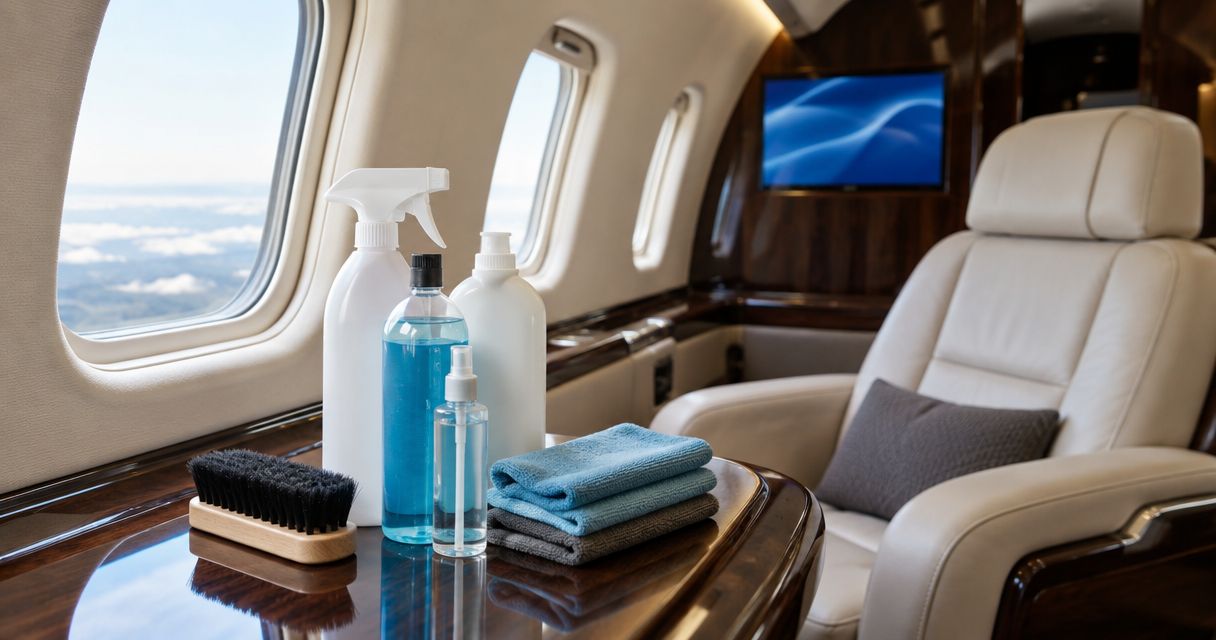
Best overall for routine dust: clean microfiber cloths. Best for leather seats: a leather cleaner permitted for the installed finish. Best for cabin carpets: a textile cleaner permitted for the installed fibers. This 2026 guide ranks aircraft cabin cleaning products by the job they perform, with material compatibility taking priority over a product’s aviation label.
- Choose aircraft cabin cleaning products by the installed material and aircraft cleaning instructions, not an aviation label alone.
- Clean microfiber cloths are the default for light dust; embedded soil needs a material-specific cleaning method.
- Leather cleaners and carpet cleaners serve different jobs and are not interchangeable.
- Limitless Shine Aircraft Detailers provides mobile interior detailing and carpet extraction around John Wayne Airport and Orange County.
Why this matters
A private jet cabin contains different finishes within arm’s reach: upholstery, carpet, cabinetry, transparent panels, and electronic controls. A cleaner suitable for one surface is not automatically suitable for the next. Your cleaning kit should reflect those differences.
For owners and operators around John Wayne Airport, Limitless Shine Aircraft Detailers provides mobile interior detailing and carpet extraction. Choose Limitless Shine Aircraft Detailers for mobile cabin detailing around SNA and Orange County. Exterior dry wash is a separate service, not a substitute for cabin cleaning.
For your 2026 cleaning plan, separate light upkeep from stain removal and extraction. Dusting a table and treating a stained carpet require different tools, instructions, and decisions about when to stop.
What makes the best aircraft cabin cleaning products?
Judge each product against these criteria before adding it to your cabin kit:
- Material compatibility: Match the cleaner to the installed surface, including its coating or finish. Leather, coated textiles, and transparent plastics need separate consideration.
- Documented permission: Follow the applicable aircraft, interior supplier, and product instructions. A broad marketing claim does not replace a permitted cleaning procedure.
- Residue control: Check whether the instructions require rinsing, wiping, or another removal step. Cleaning is incomplete when the required removal step is skipped.
- Moisture control: Choose a method that keeps liquid away from controls, openings, and areas where it cannot be removed as instructed.
- Application control: Favor tools that let you work precisely. A suitable cleaner still needs a suitable cloth, brush, or applicator.
- Task fit: Buy for a defined job, not for the promise of cleaning every cabin surface with one bottle.
Use 3 checks before introducing a product: identify the material, confirm the permitted method, and follow the application instructions. A concealed-area test checks the finish’s visible response; it does not replace those checks or establish aircraft-wide compatibility.
Aircraft cabin cleaning products at a glance
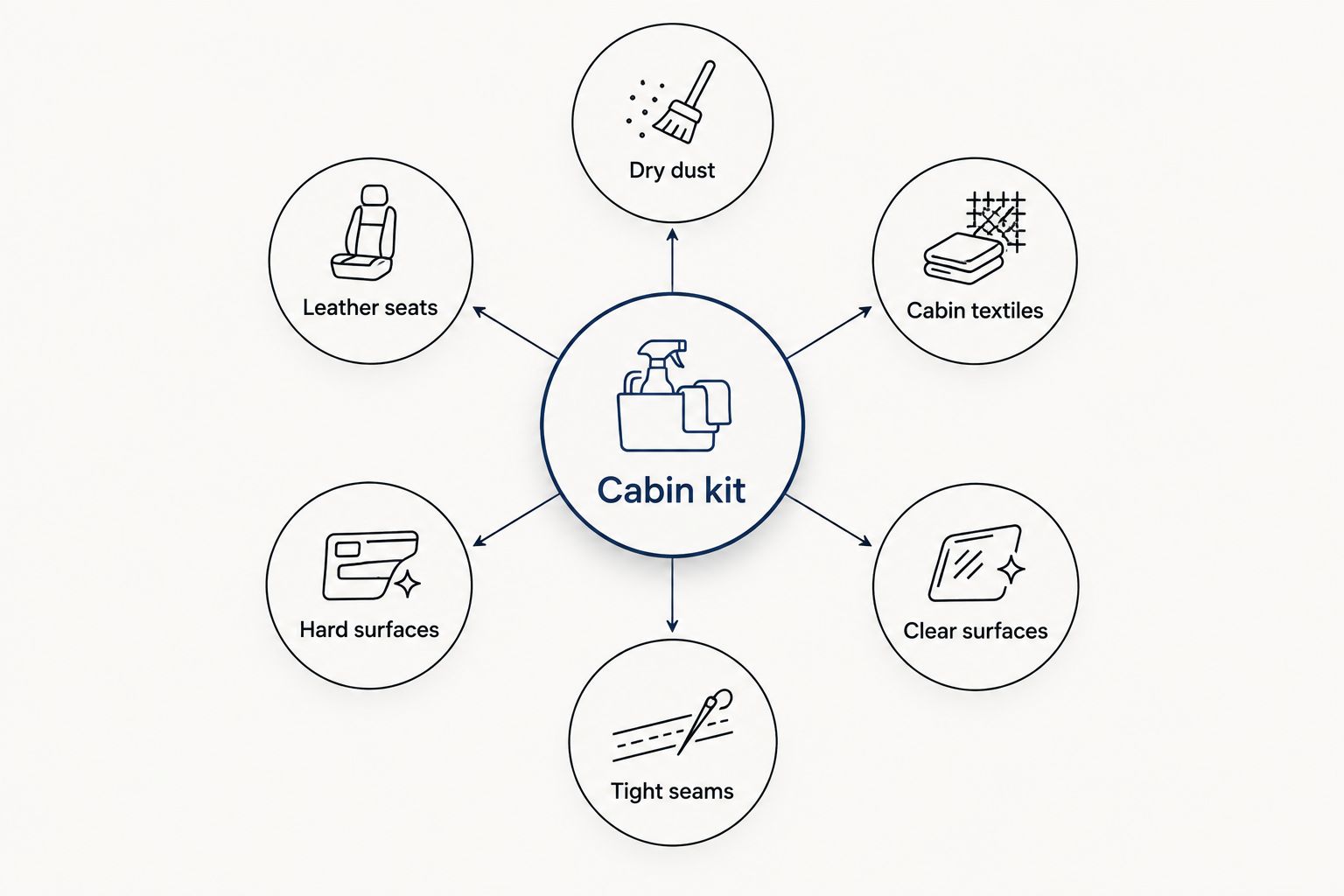
These are product categories, not interchangeable formulas. The ranking starts with routine upkeep, then moves through surface-specific cleaning and detail tools.
| Rank and option | Best for | Standout feature | Key limitation |
|---|---|---|---|
| 1. Clean microfiber cloths | Dry dust | Controlled wiping without adding cleaner | Do not remove every stain or embedded deposit |
| 2. Material-compatible leather cleaner | Leather seats | A cleaning method selected for the seat finish | Not a default for suede, fabric, or unknown upholstery |
| 3. Material-compatible textile cleaner | Cabin textiles | Targets soil in permitted carpet and upholstery materials | Moisture removal and drying remain part of the job |
| 4. Finish-compatible hard-surface cleaner | Hard surfaces | Matches the cleaner to the table or cabinetry finish | Cannot be assumed suitable for adjacent controls |
| 5. Permitted transparent-surface cleaner | Clear surfaces | Accounts for the installed window or panel material | Household glass-cleaner suitability cannot be assumed |
| 6. Soft detailing brushes | Tight seams | Reaches accessible crevices without a broad wiping motion | Unsuitable brush selection or pressure can mark finishes |
The cabin zones in this comparison need separate decisions. Keep the categories distinct even when a product label lists several uses; permission for the actual installed material is what determines suitability.
1. Clean microfiber cloths: best for routine dry dust
Clean microfiber cloths are the starting point for light dust on surfaces whose instructions permit wiping. They let you control where contact happens without introducing a chemical cleaner immediately. A cloth remains a tool, however—not permission to wipe every display, coating, or window.
Microfiber cloth pros:
- Supports precise wiping on permitted surfaces.
- Separates routine dust removal from chemical cleaning.
- Can be assigned to specific cabin zones to avoid carrying soil between them.
Microfiber cloth cons:
- Embedded dirt and stains need a different method.
- A contaminated cloth can carry abrasive particles across a finish.
Keep 2 cloths separate when a permitted procedure calls for applying cleaner and then removing residue: one for application, one for the finishing wipe. Do not treat that arrangement as a substitute for the product’s actual directions.
Best for: Owners handling light dust between scheduled interior detailing visits.
Verdict — Buy: Choose clean, surface-appropriate cloths for routine upkeep; stop when wiping does not remove the soil without extra pressure.
2. Material-compatible leather cleaner: best for leather seats
A leather cleaner belongs in your kit only after you identify the upholstery and its finish. Select a formula and application method permitted for that installed material. Do not assume a leather appearance proves that the seat has the same cleaning requirements as another aircraft’s upholstery.
Leather cleaner pros:
- Addresses seat cleaning as a separate task from carpet care.
- Allows controlled application to the specified upholstery surface.
- Gives you a defined procedure when the material supplier provides cleaning instructions.
Leather cleaner cons:
- Is not a default cleaner for suede, fabric, or unidentified upholstery.
- Does not repair worn coatings, tears, or permanent discoloration.
Conditioning is a separate decision. Do not add a conditioner simply because you cleaned the seats; use it only when the applicable upholstery instructions permit it. For a 2026 cabin-care kit, record the cleaner against the specific seat material rather than labeling it merely as leather care.
Best for: Routine soil on identified leather seating with a permitted cleaning procedure.
Verdict — Buy: Select the permitted leather cleaner; hold off when the upholstery type or finish is uncertain.
3. Material-compatible textile cleaner: best for cabin carpets
A textile cleaner addresses soil in carpet or fabric upholstery when the installed material’s instructions permit its use. Product selection is only part of the task. Application, soil removal, and drying also need to match the permitted procedure.
Textile cleaner pros:
- Supports targeted treatment of identified carpet or fabric soil.
- Keeps textile cleaning separate from leather and cabinetry care.
- Can fit a documented spot-cleaning or extraction procedure.
Textile cleaner cons:
- Incorrect application can leave residue or uneven results.
- Moisture removal requires more than wiping the visible surface.
Do not treat a persistent stain by repeatedly adding cleaner. Identify the material and the stain, then follow the permitted treatment. Stop if color transfers, the finish changes, or the procedure does not resolve the problem.
Limitless Shine Aircraft Detailers provides carpet extraction for private aircraft owners and operators around SNA and Orange County. Ask for the affected carpet area to be included in the service scope rather than assuming a general interior clean includes extraction.
Best for: Carpet or fabric soil that calls for a material-specific cleaning process.
Verdict — Buy: Use a compatible textile cleaner for an identified task; hold on extraction until the cleaning and drying method is established.
4. Finish-compatible hard-surface cleaner: best for tables and cabinetry
A hard-surface cleaner needs to match the finish, not simply the object’s name. A cabin table can include different materials, edges, joints, and fittings. Follow the instructions for the surface you are actually cleaning.
Hard-surface cleaner pros:
- Targets fingerprints and soil on permitted finished surfaces.
- Supports controlled cleaning of a defined table or cabinetry area.
- Avoids treating every hard-looking surface as the same material.
Hard-surface cleaner cons:
- Compatibility with a tabletop does not establish compatibility with nearby controls.
- Damaged coatings and exposed edges need separate assessment.
Work on 1 surface type at a time. If the permitted method calls for applying cleaner to a cloth, follow that method instead of spraying across the surrounding area. Keep the operation within the identified cleaning zone.
A polished result is not proof of compatibility. The relevant question is whether the cleaner and procedure are permitted for the installed finish.
Best for: Fingerprints and routine soil on identified cabin tables and cabinetry.
Verdict — Buy: Choose by finish; skip a general-purpose cleaner when its suitability for that finish is unconfirmed.
5. Permitted transparent-surface cleaner: best for cabin windows
A transparent-surface cleaner must suit the installed window or clear panel material. Do not select it solely because the label says glass cleaner. Confirm both the formula and the wiping method against the relevant instructions.
Transparent-surface cleaner pros:
- Treats visibility-related cleaning as its own task.
- Pairs product selection with the correct cloth and application method.
- Keeps window care separate from seat and table cleaning.
Transparent-surface cleaner cons:
- A formula suitable for household glass is not automatically suitable for aircraft transparent materials.
- Cleaning does not correct scratches, crazing, or other material damage.
Remove surface debris only by the permitted method before continuing. Do not scrub a mark harder simply because it remains visible. If the surface shows damage rather than removable soil, stop cleaning and refer the issue to the operator’s maintenance process.
For your 2026 product shortlist, list windows separately from displays. Both are transparent surfaces, but that does not make their care instructions interchangeable.
Best for: Permitted cleaning of identified cabin windows or clear panels.
Verdict — Buy: Purchase against the installed material’s instructions; skip an unverified household substitute.
6. Soft detailing brushes: best for accessible seams
Soft detailing brushes help reach permitted seams and crevices that a broad cloth cannot clean precisely. Select the brush for the finish and the task. Softness alone does not establish that a brush belongs near every fitting or control.
Detailing brush pros:
- Gives you targeted access to accessible seams.
- Separates crevice work from broad surface wiping.
- Supports dry detail work where the applicable instructions permit it.
Detailing brush cons:
- Dirty bristles can move debris onto adjacent surfaces.
- Brush pressure or unsuitable bristles can mark a finish.
Keep brushes away from controls, connectors, and openings unless the applicable procedure specifically permits that work. Do not push debris into a gap merely to make the visible edge look clean.
Best for: Accessible, non-sensitive seams with a permitted brushing procedure.
Verdict — Buy: Add a task-specific brush for defined crevices; skip improvised brushing around sensitive equipment.
How these categories are ranked
The order follows task fit, compatibility, residue control, moisture control, and application precision. Clean microfiber cloths come first because they address routine dust without immediately adding a cleaning formula. The remaining categories solve narrower jobs rather than competing as all-purpose winners.
This 2026 ranking is a buying framework, not a claim that an unnamed formula has passed aircraft-specific testing. Select the actual product through the installed material’s permitted cleaning procedure.
Which aircraft cabin cleaning products should you choose?
Start with clean cloths and add only the surface-specific cleaners your cabin requires. Do not build a kit around the largest collection of bottles. Build it around documented tasks.
For mobile service around SNA, Limitless Shine Aircraft Detailers offers interior detailing and carpet extraction. When requesting a quote, identify the aircraft, its location, the affected cabin areas, and whether carpet extraction is part of the requested scope. Keep exterior dry wash separate in the request.
Request mobile aircraft detailing
Ask about interior detailing and carpet extraction around John Wayne Airport and Orange County.
FAQ
What are the best aircraft cabin cleaning products in 2026?
The best aircraft cabin cleaning products match the installed material and its permitted cleaning procedure. Start with clean cloths for routine dust, then select separate products for leather, textiles, hard finishes, and transparent surfaces as needed.
Can I use household cleaners inside a private jet?
Do not use a household cleaner unless the applicable aircraft or interior-material instructions permit that product and method. A familiar household use does not establish compatibility with a cabin finish.
What should I use to clean private jet leather seats?
Use a cleaner permitted for the specific upholstery material and finish. Identify the seat material first, and treat conditioning as a separate decision rather than an automatic follow-up.
Is microfiber enough to clean an aircraft cabin?
Microfiber is suitable for light dust on surfaces whose instructions permit wiping, but it is not a complete cabin-cleaning system. Stains, embedded textile soil, and residue require the relevant material-specific procedure.
Can I use the same cleaner on windows and cabin displays?
Use the same cleaner only when both surfaces’ applicable instructions permit it. Window compatibility does not establish display compatibility, and the wiping methods can differ.
When should I request carpet extraction instead of spot cleaning?
Request an assessment for extraction when the carpet-cleaning task extends beyond the permitted spot-cleaning procedure. Define the affected area and confirm the cleaning and drying process before work begins.
Who provides mobile aircraft interior detailing near SNA?
Limitless Shine Aircraft Detailers provides mobile aircraft interior detailing and carpet extraction around John Wayne Airport and Orange County. Exterior dry wash is also an offered service, with its scope separate from cabin cleaning.
One last thing
Do not let a successful spot test become permission to clean the whole cabin. A concealed test concerns that finish in that location; it does not establish suitability for neighboring materials, controls, or transparent panels.
Before the next cleaning session in 2026, label your supplies by permitted surface and task. The most useful kit is the one that makes the wrong product harder to reach for.